Australia’s Social Media Ban – Life Beyond the Scroll
For more than a decade, teens have grown up inside a constant feedback loop of likes, posts and personalised content. On the 10th of December, Australia will take the unprecedented step of trying to disrupt a digital culture that has shaped an entire generation.
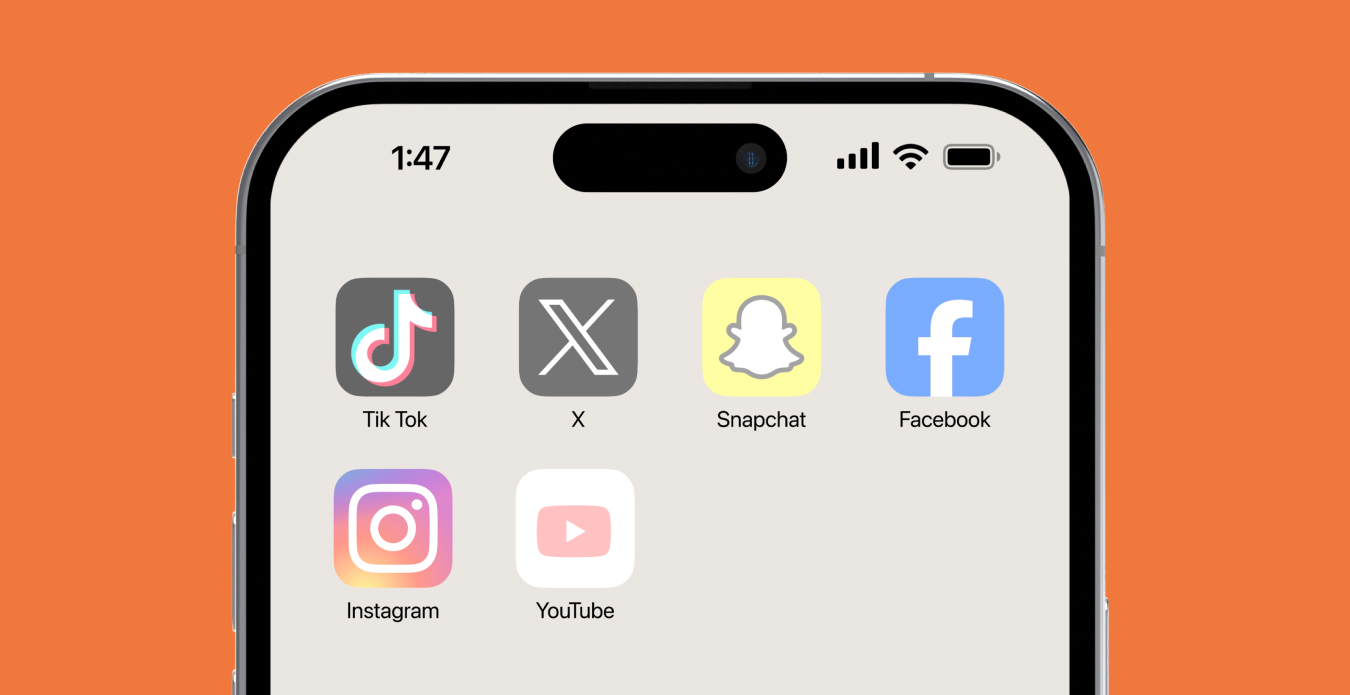
Under the new social media ban, teens will no longer be able to create, manage or post on personal accounts across platforms such as TikTok, Instagram, X, Snapchat, Facebook and YouTube. The change is designed to act as a developmental ‘delay’, giving kids a few extra years to build the emotional and social maturity they need to safely engage with the online world. But beyond rewriting the rules of platform access, this shift has the potential to slowly reshape how younger generations perceive and interact with the digital world.
Designed to Be Addictive
From a behavioural science lens, repeated exposure to rewarding stimuli creates powerful, self-reinforcing habit loops. While we normally associate these kinds of loops with behaviours like gambling or substance abuse, social media operates in a very similar way, partciularly on young minds. Whether it’s seeing TikTok content pop up from your favourite creator or receiving some e-love on your most recent Instagram post, these psychological rewards are unpredictable, and highly addictive. It is this very same variable reward system that makes slot machines so hard to walk away from.
Up until now, there has been virtually no friction between teens and the endless cycle of checking, posting and scrolling on social media. This has paved the way for a widespread migration away from outdoor activities and face-to-face socilalising, and towards more isolated, indoor screen time. Smartphone ownership among 12- to 15-year-olds has more than trippled since 2010 to a staggering 87%, and almost all Aussie kids now say they use social media frequently.
At the same time, youth mental health challenges continue to intensify across Australia. Over the last 15 years, hospitalisations for intentional self-harm have doubled, with the highest rates coming from females in the 15 – 19 age group. Social media isn’t the sole driver of this trend, but it’s contribution to the growing emotional strain teens are facing is impossible to ignore. Many children report exposure to harmful content online, ranging from cyberbullying and misogynistic material to content promoting eating disorders. The risk within these online environments has simply become too hard to ignore, and has tipped the scales towards a formal nationwide intervention.
The beginning of a new digital relationship
Despite the overwhelming majority of Aussies supporting the governments proposed media regulations, critics have been quick to point out the enforcement hurdles and privacy concerns that come with a change of this magnitude. Rolling out an age-verification system at scale won’t be simple. Teens who are already active on social media will almost certainly attempt to work around the rules – and being as tech-savvy as they are, some will probably succeed. But if and when these teething issues are resolved, the ban carries the potential to create a long-term cultural shift among young Aussies.
Humans are social creatures, and a lot of what we do is shaped by what those around us are doing. We are wired to pay attention to and mimic the behavioural norms of our peer groups, a principle called social proof. When all your friends are posting and liking content online, stepping away can feel like stepping out of the social conversation altogether. But for the first time, an entire cohort will grow up without social media being a default behaviour.
This shift doesn’t just interrupt the social media habit loop, it reshapes the norms and expectations surrounding online life. With fewer teens on social media platforms, the cultural pull weakens, and the frequency of the behaviour decreases. This kind of cultural shift does not happen overnight, but when it does take hold, it tends to stick.
What This Means for Marketers
The social media age restriction for Australian teens under 16 Aussie isn’t just a regulatory milestone, it’s the first structural attempt to interrupt the behavioural machinery that has kept young people online for two decades. Whether the policy succeeds, fails or evolves into something entirely new, it signals the start of a new digital lanscape, one where the next generation may grow up a healthier distance from the scroll.
For brands, communicators and the future of social media marketing, this moment is a reminder that youth culture is shifting, and with it, the platforms, behaviours and expectations that have defined the attention economy. As teens spend less time in algorithmic ecosystems, influence will redistribute and digital habits will realign.
The opportunity for brands isn’t to ‘reach’ young people differently, but to rethink how they show up in a world where wellbeing, boundaries and healthier digital norms are becoming a part of the cultural conversation. And in that world, its the brands who learn to respect, reflect and reinforce those boundaries that will be the ones young Australians choose to trust.